
Imposter : Word Party Game
CodevaRole Playing
4.645.00 Reviews
- Version
- 1.9
- Installs
- 50.00K
- Age Rating
- Everyone
Screenshots
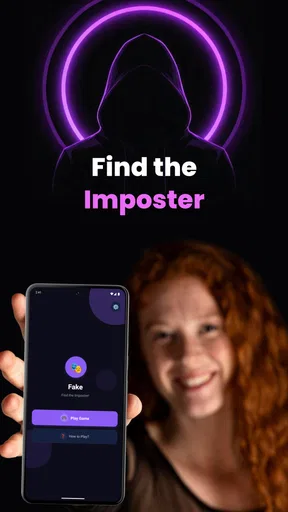
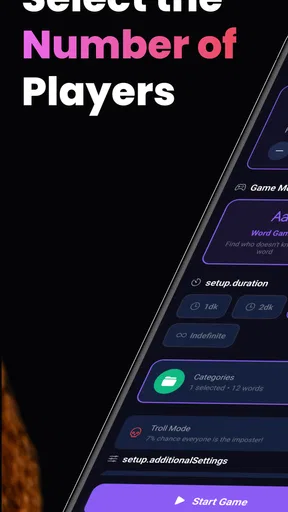
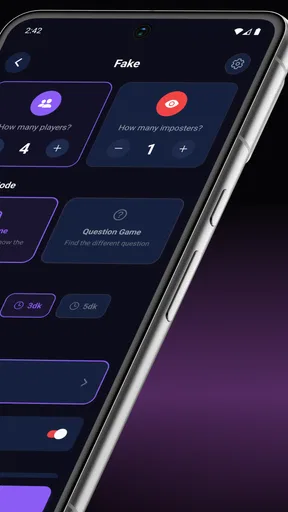
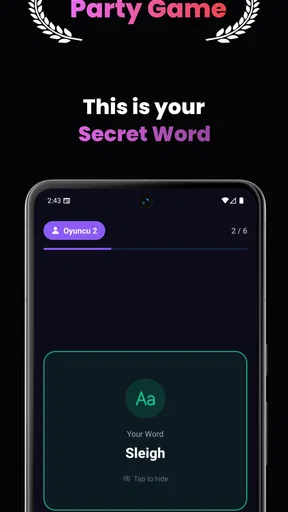
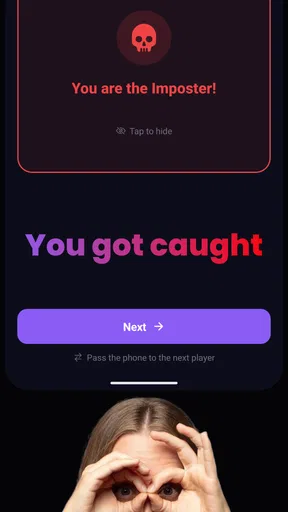
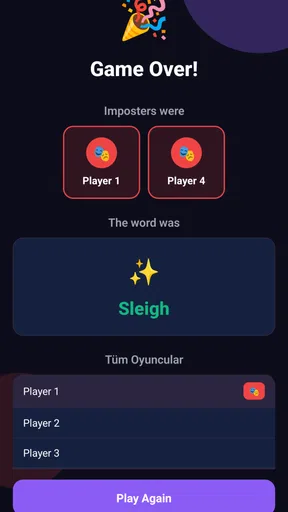
Our Review of Imposter : Word Party Game
 Analysis by Appyee
If you are looking for a quick party game that works without turning the evening into a complicated setup, Imposter: Word Party Game is easy to understand from the moment you open it. I played it as a social role-playing game built around one simple challenge: identify the player who does not belong, while trying not to reveal too much about your own position. The free download from Codeva is aimed at everyone, and its appeal is less about long-term character progression than about conversation, bluffing, suspicion, and the funny mistakes that happen when a group reads too much into a single answer.
The first thing I would tell a friend is that this is not a solo role-playing adventure with a large world to explore. It is a face-to-face party activity, best enjoyed when several people are already together. The phone acts as the facilitator, passing information between players and giving the group a structure for the round. That makes it useful for a family gathering, a casual night with friends, or a short break when nobody wants to learn a complicated board game.
The important expectation is social rather than technical: the quality of a round depends heavily on how willing everyone is to speak, listen, bluff, and accuse one another. If your group enjoys guessing games, the format becomes lively very quickly. If everyone prefers quiet individual play, the app will feel limited because its central entertainment comes from the people around the screen.
What the first round feels like
The premise is deliberately compact. Most participants receive enough information to discuss a hidden subject, while one person must blend in and work out what is happening from the conversation. Players then give clues or answer prompts in a way that sounds convincing without making the secret too obvious. The group watches for answers that are too vague, too confident, or suspiciously well timed.
That balance creates the best moments. A player who knows the subject can accidentally expose it by being overly specific. The imposter can sometimes survive by giving a broad answer that fits several interpretations. Meanwhile, an innocent player may look guilty simply because they hesitate. I like that the game does not require elaborate acting or a large rules briefing. The social reading is the challenge, and every person brings a different style to it.
For a first-time user, the most useful mindset is to treat the opening round as practice rather than a test. You do not need to understand every possible tactic before starting. Pay attention to the order of turns, notice how information is presented, and let the group establish its own rhythm. By the second round, people usually begin adjusting their answers instead of speaking randomly.
The game is especially suitable for groups that want something shorter than a full board-game session. It can fill an awkward pause before dinner, give a mixed-age family a shared activity, or provide a simple warm-up before a longer evening. Because the age rating is Everyone, it is also a more approachable choice when the group includes younger players, although adults may still need to explain the idea of bluffing and avoid turning accusations into personal criticism.
Getting from installation to the first meaningful success
After installing the game, I recommend starting with the smallest comfortable gathering rather than inviting a large crowd immediately. Put the phone where everyone can reach it, decide who will handle it first, and agree that private information should be viewed carefully. That small bit of organization matters more than it sounds. If players hold the device too openly or pass it around while talking, the hidden role can become obvious for reasons unrelated to skill.
Before beginning, tell everyone the basic social rule: clues should be useful enough to show that a player understands the subject, but not so direct that they give the answer away. This prevents the first round from becoming a series of one-word guesses. It also gives the imposter a fair chance to follow the discussion instead of being exposed by an accidental giveaway.
When your turn arrives, listen to the earlier answers before deciding how specific to be. A strong first move is often a clue that describes a quality, context, or feeling rather than naming the most recognizable detail. For example, if the hidden subject relates to something commonly used, describing when people encounter it may be safer than mentioning its most distinctive feature. This is not a fixed rule, but it helps new players avoid making the answer obvious.
Your first successful action does not have to be catching the imposter. It can simply be giving a clue that fits the group’s discussion without exposing the subject. That is a useful early goal because it teaches the central trade-off: sounding informed while leaving room for uncertainty. Once you can do that consistently, you are ready to pay closer attention to the players whose answers do not match the tone or level of detail established by the group.
If you are the imposter, resist the urge to speak first unless the group’s format requires it. Early answers are valuable because they reveal the direction of the conversation. Listen for repeated ideas, compare how specific the others are, and choose a response that connects to what has already been said. A broad but relevant clue is usually safer than an elaborate explanation that exposes your lack of context.
Small tactics that make the game fairer and funnier
One practical tactic is to vary the level of detail from round to round. If every participant always gives a highly precise clue, the imposter has little chance to recover. If everyone is vague, the discussion becomes random. I found that the most enjoyable rounds happen when clues are understandable in hindsight but not immediately decisive. The group should have enough material to debate, not enough to solve the puzzle instantly.
Another useful habit is to separate suspicious behavior from personal behavior. A quiet person is not automatically the imposter, and an enthusiastic speaker is not automatically innocent. Some players naturally explain more than others. I get better results when I ask whether an answer fits the conversation rather than judging someone’s personality. That makes the game more welcoming and reduces the chance that a shy participant is singled out every time.
There is also a subtle timing advantage in watching who changes their story. A player may begin with a broad clue and later become unusually precise after hearing others. That shift can be meaningful, especially if it seems designed to imitate the group. On the other hand, a knowledgeable player may simply be refining their answer. The best accusation usually comes from a pattern across several clues, not one awkward sentence.
For hosts, the order of turns can change the difficulty. Letting the same person always begin may make that player too influential, while rotating the starting position keeps the discussion less predictable. This is a simple house rule, but it gives repeat sessions more variety without changing the basic game. It also helps players learn that being first is not always an advantage.
Where new players commonly get confused
The biggest confusion is assuming that the aim is to provide the most accurate clue possible. In reality, an accurate clue can be a poor clue if it reveals the hidden subject immediately. The useful answer is one that demonstrates enough understanding to protect you from suspicion while preserving uncertainty for everyone else. New players often need one round to feel the difference between being correct and being strategically correct.
Another point of friction is the temptation to interrogate one person too early. If the group focuses on a single player after one unusual answer, the imposter can quietly follow the majority while an innocent participant spends the rest of the round defending themselves. I prefer a short comparison of several answers before anyone commits to an accusation. This keeps the discussion active and gives the hidden role a more interesting challenge.
Some groups may also expect the phone to do all the explaining. It is better to treat the app as the round organizer and let one human player clarify the social rules. The people in the room still need to agree on how much discussion feels fair, whether interruptions are allowed, and how accusations should be handled. Establishing those expectations at the start prevents arguments that have nothing to do with the game itself.
The free-to-play model is worth considering before a group settles into regular sessions. The game is free to download, while optional in-app purchases range from $4.99 to $29.99 per item. I would begin without spending anything and see whether the basic party format suits your group. That is particularly sensible for occasional players who may only open it during gatherings. Regular groups can decide later whether extra paid content or options are valuable to them, but the purchase decision should not be confused with learning the core game.
Performance expectations should also be realistic. The current version is 1.9 and it supports devices running Android 7.0 or later. That makes it accessible to many older Android phones, but the experience still depends on the device being passed carefully and the group being able to view information privately. A larger screen may be more comfortable for a group, while a smaller phone can work if players take turns and avoid crowding around it.
Who will enjoy it, and who should skip it
I would recommend this game to people who like social deduction but do not want a long rulebook. It works well for friends who enjoy teasing one another, families looking for a shared activity, and hosts who need a quick game that can be explained while everyone is already seated. It is also a good choice for players who enjoy improvising answers rather than planning several turns ahead.
It is less suitable for someone seeking a deep role-playing campaign, collectible progression, or a substantial solo experience. The role-playing label describes the act of taking a hidden social role, not a character-building system with quests and equipment. If your preferred games involve exploration, persistent worlds, or detailed strategic planning, this will feel intentionally lightweight.
I would also skip it for groups that dislike bluffing or interpret accusations too seriously. The game naturally creates suspicion, and that is entertaining only when everyone understands that the accusation is part of the rules rather than a real judgment. For a workplace gathering or a group of strangers, a gentler icebreaker may be a better first choice unless someone is willing to guide the tone.
Compared with a traditional card-based hidden-role game, this app is more convenient because the phone can manage secret information and reduce the need to prepare components. Compared with a large online multiplayer title, it is more immediate and personal because everyone is physically present. The trade-off is that it offers less of the persistent progression and expansive content found in larger role-playing games. Its strength is the short social loop, not a huge amount of material to master.
A realistic evening with the game
Imagine a few friends waiting for food at a casual gathering. Nobody wants to start a game that requires a table full of pieces, but conversation has slowed. One person opens Imposter: Word Party Game, explains that everyone should protect the hidden subject while one player tries to fit in, and passes the phone around privately. The first round is slightly messy because people give clues that are either too obvious or too broad.
That mess is useful. In the next round, players begin to notice how much detail is safe. One person deliberately gives a clue that could fit two possibilities, another watches for answers that copy the previous speaker, and the hidden player waits until the conversation provides enough context. Even if the final accusation is wrong, the group has a clear reason to debate it. That is the kind of everyday success the game offers: not a dramatic victory screen, but a conversation that becomes more engaging because everyone has a small secret to protect.
For children or mixed-age groups, I would choose simple subjects in the conversation and avoid pressuring anyone to speak before they are ready. Adults can make the game harder by using indirect clues and paying attention to changes in confidence. The same basic session can therefore work for different ages, provided the host keeps the language clear and the accusations friendly.
How to make the next session better
Once your group understands the basic flow, introduce a short discussion limit before voting. A limit prevents the most talkative player from controlling the entire round and gives quieter participants a reason to offer a clue. I would not make the limit so strict that people cannot explain themselves, but a defined window keeps the game moving and makes repeated sessions feel less repetitive.
You can also ask players to remember one clue from each participant before the vote. This encourages active listening instead of immediate suspicion. When the role is revealed, compare the successful and unsuccessful clues. That quick review is one of the best ways to improve, because it shows whether the group was fooled by a genuinely flexible answer or distracted by someone’s delivery.
Another advanced approach is to assign value to restraint. A player who knows the subject does not need to prove it by giving the cleverest clue. Sometimes the safest contribution is a modest answer that supports the discussion without becoming its center. This is especially useful for experienced groups, where obvious confidence can be as suspicious as obvious uncertainty.
Codeva’s game has earned a 4.6 average from over 700 ratings, with more than 45 written reviews and over 50 thousand installs. Those figures suggest that it has found an audience among people who want a compact social game, but they should not replace your own judgment about the group you plan to play with. A strong rating cannot make a reluctant group enjoy bluffing, while a willing group may have fun even when a round goes imperfectly.
For me, the best reason to try it is the low barrier between installation and participation. You do not need to prepare a board, learn a large set of exceptions, or commit to a long campaign. You do need people who are ready to talk and a host who protects private information during setup. If those conditions are present, the first meaningful success can arrive quickly: give a careful clue, notice a contradiction, and help the group reach a reasoned vote.
My final recommendation is simple: download it if you want a free, conversation-driven party game for Android and your group enjoys playful suspicion. Start with one relaxed round, avoid spending money until you know the format fits, and treat early mistakes as part of learning the balance between clarity and secrecy. I would not choose it as a replacement for a deep role-playing game or a solo pastime, but as a compact face-to-face activity, it has a clear purpose and delivers that purpose without unnecessary complexity.
Verdict
Strengths of Imposter : Word Party Game
- Simple rules make it easy for new players to join quickly.
- Short rounds keep matches lively and suitable for casual play.
- Encourages creativity, bluffing, and careful observation.
- Works well for parties, family gatherings, and group chats.
- Different word prompts can make each round feel unpredictable.
Limitations of Imposter : Word Party Game
- The experience depends heavily on having enough players available.
- Repeated prompts may reduce replay value over time.
- Players may disagree about vague or overly subjective answers.
- Voice or text communication may be needed for the best experience.
- Ads or optional purchases may interrupt the flow of some sessions.
Similar Picks in This Category
View All
Hair Dye
CrazyLabs LTD4.4

Monster High™ Beauty Salon
CrazyLabs LTD4.5

Bus Simulator - Bus Games 3D
Jima Apps4.4

Flight Pilot: 3D Simulator
Wildlife Studios4.1


Super Stylist Fashion Makeover
CrazyLabs LTD4.4
Frequently Asked Questions
What is Imposter: Word Party Game and how is it played?
Imposter: Word Party Game is a social deduction party game built around hidden roles, secret words, and quick conversations. Most players receive the same word or topic, while one or more imposters must blend in without knowing the answer. Players give clues, discuss suspicious responses, and vote to identify the imposter before the round ends. The exact rules may vary by game mode, so it is worth checking the selected settings before starting.
Can I play Imposter: Word Party Game with friends, or is it suitable for solo play?
The game is primarily designed for group play, making it a good choice for parties, family gatherings, and casual sessions with friends. Everyone needs to participate in the same round and pay attention to the clues being given. It is not intended to replace a traditional single-player game, although you may be able to practice or explore some features alone depending on the version installed. A larger group generally makes the deception and voting more entertaining.
How many people are needed to play Imposter: Word Party Game?
The ideal number of players depends on the game mode and the number of imposters selected, but the experience is usually more enjoyable with at least four participants. With too few players, it can be easier to guess the imposter immediately and the discussion may feel limited. Larger groups create more uncertainty, although everyone should still have enough time to give clues and defend their answers during each round.
Does Imposter: Word Party Game require an internet connection?
Many party games of this type are designed for local, face-to-face play and may allow players to share one device, which can make them convenient for gatherings. However, internet requirements can differ between versions and may apply to advertisements, updates, online features, or downloading additional content. Before relying on the game at a party, install it in advance and test the main game mode to confirm whether offline access is available on your Android or iOS device.
Is Imposter: Word Party Game free to download, and does it contain ads or in-app purchases?
The app may be available as a free download, but free access can include advertising, optional purchases, or limitations on certain content and features. These details can change with updates, regional availability, and the platform’s store listing. If you are downloading it for children or a group event, review the current price information, permissions, and in-app purchase settings first. Also remember that the game’s social experience depends more on the players than on paid extras.
Play our best games!


